Short Answer
- Keep Opus 5.5 as your default for everyday coding, writing, terminal and DevOps agents, and high-volume pipelines. Anthropic itself calls it the "strongest daily driver".
- Use Fable 5.2 for long agent runs, hard migrations, research over charts and documents, CAD and 3D geometry, robotics and science workloads, and any task Opus 5.5 failed twice.
- Compare at matched effort, not default effort. In the API, Fable 5.2 defaults to
highand Opus 5.5 tomedium. Without changing anything, a Fable task costs 3.7x more, and most of that comes from the effort level, not the model.
Fable 5.2 vs Opus 5.5: Specs and Pricing
| Claude Fable 5.2 | Claude Opus 5.5 | |
|---|---|---|
| Release date | November 9, 2026 | September 22, 2026 |
| API model ID | claude-fable-5-2 |
claude-opus-5-5 |
| Input / output price | $8 / $40 per 1M tokens | $4 / $20 per 1M tokens |
| Cache read / cache write | $0.20 / $10 per 1M tokens | $0.20 / $5 per 1M tokens |
| Fast mode (up to 2.5x output speed) | $16 / $80 per 1M tokens | $8 / $40 per 1M tokens |
| Context window / max output | 1M / 128K tokens | 1M / 128K tokens |
| Thinking | Adaptive, always on | Adaptive, always on |
| Default effort (API) | high | medium |
| Output speed (Artificial Analysis) | 87 to 103 tokens/s | 103 to 115 tokens/s |
| Data retention | 30-day retention required, no zero data retention unless Anthropic authorizes it | Standard |
Fable 5.2 also replaces Fable 5.1 at a lower price ($8 / $40, down from $10 / $50) and, according to Anthropic, generates output up to 30% faster than Fable 5.1. Opus 5.5 still produces tokens faster, but that matters less than it looks: at matched intelligence, Fable 5.2 often finishes the task sooner because it needs fewer steps. More on that in the cost section.
Fable 5.2 vs Opus 5.5 Benchmarks: Full Table
Three sources, merged into one table. Anthropic's launch figures use each model's highest available effort. BenchLM aggregates published results. Artificial Analysis (AA) runs its own evaluations; we show its max-effort rows here. Opus 5.5 rows are in bold where Opus wins.
| Benchmark | What it tests | Fable 5.2 | Opus 5.5 | Gap | Source |
|---|---|---|---|---|---|
| FrontierCode 2.0 | Agentic coding | 49.1% | 45.5% | +3.6 Fable | Anthropic |
| FrontierSWE v2 | Agentic coding | 69.9% | 62.3% | +7.6 Fable | Anthropic |
| SWE-bench Pro | Real repo fixes | 93.0% | 89.9% | +3.1 Fable | BenchLM |
| SWE Multimodal | Fixes from screenshots / UI | 74.1% | 61.4% | +12.7 Fable | BenchLM |
| CursorBench 4.0 | IDE coding tasks | 60.0% | 57.8% | +2.2 Fable | BenchLM |
| Terminal-Bench 4.0 | Shell / DevOps agents | 67.6% | 66.4% | +1.2 Fable | BenchLM |
| ProgramBench | Program synthesis | 85.6% | 91.2% | +5.6 Opus | BenchLM |
| AutomationBench | Business workflows | 51.4% | 42.5% | +8.9 Fable | Anthropic |
| Terminal-Bench-Science 0.1 | Agentic science | 74.6% | 58.7% | +15.9 Fable | Anthropic |
| WANDR (relaxed) | Agentic web search | 82.1% | 72.3% | +9.8 Fable | Anthropic |
| OSWorld 2.1 (offline) | Computer use | 89.3% | 87.2% | +2.1 Fable | Anthropic |
| RoboDojo Sim | Robotics | 64.9% | 39.4% | +25.5 Fable | Anthropic |
| Remote Labor Index | Paid freelance-style projects | 41.3% | 21.3% | +20.0 Fable | Anthropic |
| Humanity's Last Exam (tools) | Expert-level questions | 74.2% | 67.7% | +6.5 Fable | Anthropic |
| Chartography (no tools) | Reading charts | 73.4% | 64.4% | +9.0 Fable | Anthropic |
| BenchCAD 2.1 (tools) | CAD modeling | 83.5% | 65.3% | +18.2 Fable | Anthropic |
| BenchCAD 2.1 (no tools) | CAD modeling | 75.4% | 49.0% | +26.4 Fable | BenchLM |
| AA-Briefcase v1.1 (rubric) | Knowledge-work deliverables | 66.1% | 61.2% | +4.9 Fable | Anthropic |
| AA-Briefcase v1.1 (Elo) | Head-to-head preference | 1785 | 1800 | +15 Opus | Anthropic |
| PhysicianBench | Clinical reasoning | 64.4% | 68.4% | +4.0 Opus | BenchLM |
| GMMLU | Multilingual knowledge | 96.0% | 94.3% | +1.7 Fable | BenchLM |
| Intelligence Index (max) | AA composite | 65 | 59 | +6 Fable | AA |
| AA-Omniscience v1.1 (max) | Knowledge without hallucinating | 67 | 48 | +19 Fable | AA |
| GDP.pdf (max) | Document tasks | 24.2% | 26.2% | +2.0 Opus | AA |
Score: Fable 5.2 wins 20 rows, Opus 5.5 wins 4. The headline numbers hide three patterns that matter more than the total:
- The gap is small on coding and huge on everything else. On text-only coding benchmarks, Fable leads by 1 to 8 points, and Opus wins ProgramBench outright. The big gaps (+16 to +26 points) are in robotics, CAD, science, and long freelance-style projects. If your work is mostly code, Fable 5.2 is a smaller upgrade than its average suggests.
- Terminal-Bench 4.0 is basically a tie. 67.6% vs 66.4% on BenchLM, and both at 59.6% at max effort on Artificial Analysis. Shell-heavy agents (CI, infra, deployments) get almost nothing from Fable.
- Fable 5.2 hallucinates less, even at low effort. On AA-Omniscience, Fable at low effort scores 63 and Opus at max scores 48. Thinking longer does not fix missing knowledge. Cognition's comment at launch says the same thing: "Claude Fable 5.2 says it doesn't know things instead of hallucinating."
One row deserves a second look: AA-Briefcase. Fable 5.2 meets more rubric criteria (66.1% vs 61.2%), but evaluators comparing the two outputs side by side slightly prefer Opus 5.5 (Elo 1800 vs 1785). We read this as a difference in presentation, not correctness. It also matches what many developers said when Fable 5.1 came out: Opus writes in a style people prefer.
Cost per Task: Why 2x the Price Is Not 2x the Bill
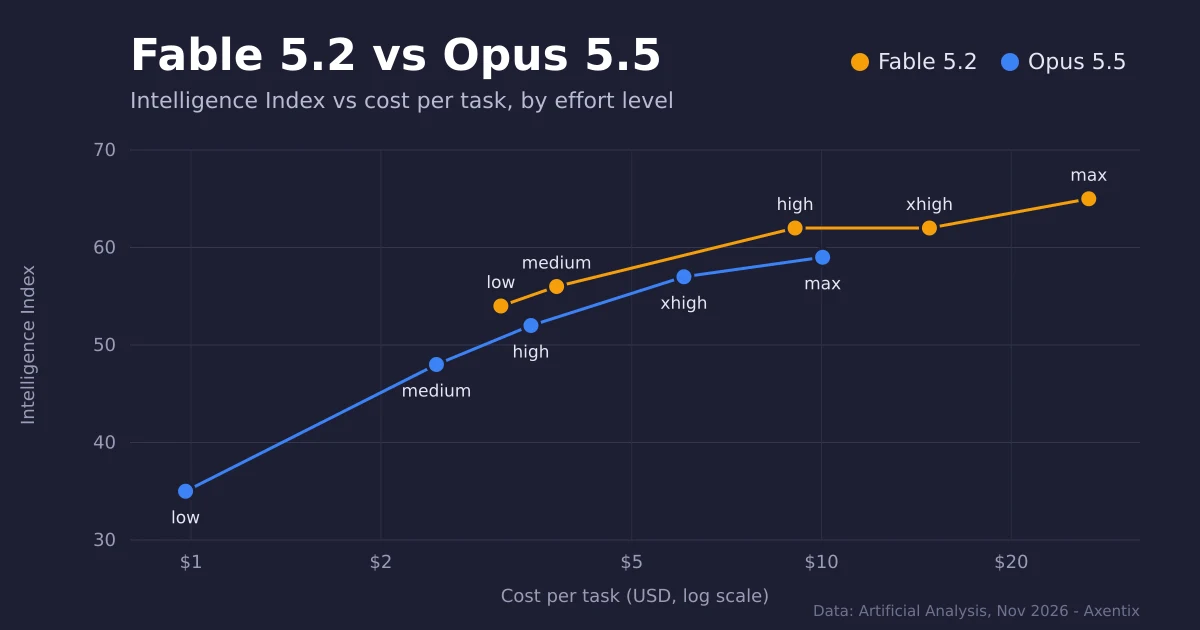
Price per token and cost per finished task are different numbers. Artificial Analysis publishes both for every effort level. Here are all ten configurations, sorted by cost per task:
| Model (effort) | Cost per task | Intelligence Index | Time per task | Time to first token |
|---|---|---|---|---|
| Opus 5.5 (low) | $0.98 | 35 | 3.0 min | 5.0 s |
| Opus 5.5 (medium) | $2.45 | 48 | 7.1 min | 13.3 s |
| Fable 5.2 (low) | $3.10 | 54 | 6.5 min | 6.4 s |
| Opus 5.5 (high) | $3.46 | 52 | 9.5 min | 25.4 s |
| Fable 5.2 (medium) | $3.80 | 56 | 8.3 min | 12.6 s |
| Opus 5.5 (xhigh) | $6.05 | 57 | 16.2 min | 76.4 s |
| Fable 5.2 (high) | $9.08 | 62 | 17.4 min | 30.5 s |
| Opus 5.5 (max) | $10.04 | 59 | 25.1 min | 372.1 s |
| Fable 5.2 (xhigh) | $14.83 | 62 | 26.3 min | 74.6 s |
| Fable 5.2 (max) | $26.54 | 65 | 44.6 min | 221.2 s |
Read it in matched pairs and the picture changes:
- Fable low vs Opus high: $3.10 vs $3.46, 54 vs 52, 6.5 vs 9.5 minutes. Fable is cheaper, smarter and 30% faster.
- Fable medium vs Opus xhigh: $3.80 vs $6.05 for nearly the same score (56 vs 57), in half the time.
- Fable high vs Opus max: $9.08 vs $10.04, 62 vs 59, 17.4 vs 25.1 minutes. Opus 5.5 at max effort is beaten on all three axes, so there's no reason to run it.
- Where Opus wins: under $3 per task. Opus at low and medium effort has no Fable equivalent, and that is where most production traffic sits.
- Where Fable stops paying off: xhigh costs 63% more than high for the same Intelligence Index (62). Anthropic gives the same advice: start Fable 5.2 at high and use xhigh only where you have measured a gain.
Anthropic's launch numbers point the same way. On FrontierCode 2.0, Fable 5.2 at high effort scores 45.3%, level with Opus 5.5's best score (45.5%), for roughly half the cost per task. On Chartography, Fable at medium scores 66.4%, above Opus 5.5 at max (64.4%), for under one-tenth of the cost. On Humanity's Last Exam, Fable at low effort matches Opus's top score for under one-tenth of the cost.
Treat vendor matched-cost claims as a starting point, not a guarantee. These are Anthropic's chosen tasks, and cost per task on Artificial Analysis is an average over its own evaluation suite. Your tasks will behave differently.
Caching does not change the ratio
Cache reads cost $0.20 per million tokens on both models, so you might expect long cached contexts to close the gap. They don't, because output tokens drive the bill. Example: an agent session that reads 2M input tokens (90% cache hits) and writes 80K output tokens.
| Line item | Opus 5.5 | Fable 5.2 |
|---|---|---|
| 1.8M cache reads | $0.36 | $0.36 |
| 0.2M uncached input | $0.80 | $1.60 |
| 80K output (incl. thinking) | $1.60 | $3.20 |
| Total | $2.76 | $5.16 |
Output is 58% of the Opus bill and 62% of the Fable bill. Effort is the setting that controls output and thinking tokens, which is why Fable at a lower effort can cost less than Opus at a higher one. If you only take one thing from this article: pick the effort level first, then the model.
Real Use Cases: Which Model Wins
Benchmarks become useful once you map them to actual jobs. For each common workload, here is the model and effort level we would start with, and the data point behind the choice.
| Use case | Start with | Why |
|---|---|---|
| Bug fixes, small features, PR reviews | Opus 5.5, medium | Most coding gaps are 1 to 4 points; Opus medium ($2.45/task) is cheaper than any Fable config |
| Multi-hour migration or refactor | Fable 5.2, high | FrontierSWE +7.6, Remote Labor Index roughly 2x; Fable high beats Opus max on cost and time |
| CI, infra, shell agents | Opus 5.5, medium or high | Terminal-Bench 4.0 is a tie; Opus streams about 12% faster on average |
| Research over PDFs, charts, reports | Fable 5.2, medium | Chartography medium beats Opus max at under 1/10 the cost; WANDR +9.8 |
| 3D scenes, CAD, geometry code | Fable 5.2, high | BenchCAD 2.1 is the largest gap of all (+26.4 without tools) |
| UI from screenshots or mockups | Fable 5.2, medium | SWE Multimodal +12.7 |
| Business automation (CRM, email, sheets) | Fable 5.2, medium | AutomationBench +8.9; WANDR at medium matches Opus's best for about 40% of the cost |
| Client-facing writing, docs, decks | Opus 5.5, medium | Preferred head-to-head on AA-Briefcase Elo, at half the price |
| Factual Q&A where wrong answers are costly | Fable 5.2, low | AA-Omniscience 63 at low vs 48 for Opus at max |
| Classification, extraction, subagents at volume | Neither: Sonnet 5.5 or Haiku 5.5 | Opus low ($0.98/task) is the floor of this comparison; smaller models go lower |
Everyday coding in Claude Code
For tickets, small features and code review, Opus 5.5 is still the better deal. The coding benchmarks are close,
Opus wins ProgramBench, and on Pro and standard Team seats Fable is capped at 50% of your weekly usage during the
launch promotion. A workflow that works well: stay on Opus 5.5, and switch to Fable 5.2 with
/model when Opus has
failed the same task twice or the task spans many files and hours. If you run Claude inside an editor, our guide
on using Claude with
Cursor covers model selection there.
Long agent runs and migrations
This is the clearest case for Fable 5.2. Remote Labor Index (real freelance-style projects) almost doubles, from 21.3% to 41.3%. Partners describe the same behavior at launch: Uber says it "works until the job is actually complete instead of stopping at a plausible checkpoint", and Vercel says "I haven't had to say 'No, I meant...' a single time." On long runs, retries and human corrections cost far more than tokens. A model that needs fewer of them is cheaper even at 2x the token price.
3D work: three.js, Blender scripts, CAD
The "Fable 5.2 vs Opus 5.5 for 3D work" question comes up a lot, and the data supports it: BenchCAD 2.1 shows the widest gap of any benchmark (75.4% vs 49.0% without tools, 83.5% vs 65.3% with tools). Building geometry from a description takes spatial reasoning, and spatial reasoning is where Fable 5.2 pulls furthest ahead. Our split: use Fable 5.2 to generate the first version of a scene, rig or part, then use Opus 5.5 for the cheap follow-ups (colors, camera moves, small parameter changes). Peter Yang's side-by-side video includes two 3D tests (a Kyoto travel video built in code and a kart racing game) and shows every prompt and result. Watch it before deciding. He also reports one test where Opus still wins.
Research, charts and document analysis
This is the best value case for Fable 5.2, because it wins at medium effort. Chartography at medium (66.4%) beats Opus at max (64.4%), WANDR agentic search is +9.8, and AA-Omniscience shows fewer made-up facts. For due diligence, market research or reading many reports that contradict each other, Fable medium is both cheaper and more reliable than pushing Opus to max. GDP.pdf is the exception: Opus scores slightly higher on that document benchmark, so test your own PDF-heavy workloads before switching.
Writing and pushback
For essays, docs and client deliverables, start with Opus 5.5: people slightly prefer its outputs head to head,
and it costs half as much. Neither model is free of generic AI phrasing by default. A short style block in
CLAUDE.md or your system
prompt (active voice, no filler words, no hedging, no flattery) makes more difference than the model choice. Peter
Yang's video also tests which model holds its position when the user pushes back, which is worth watching if you
use Claude to review decisions.
Security and biology work
Fable 5.2 runs cyber and biology classifiers. When a query is blocked, Anthropic answers it with Opus 4.8 for
cyber and Opus 5 for biology. Anthropic reports about 55% fewer false-positive blocks than Fable 5.1. Verified
cyber and life-sciences organizations can request Claude Mythos 5.2, the same model offered
through Anthropic's verification programs. Opus
5.5 also has cyber and bio classifiers, so switching models does not remove refusals. In the API, handle the
refusal stop reason
on both.
Route Between Them in the API
Anthropic's own model guide says to start with Opus 5.5 and move to Fable 5.2 when your evals at xhigh or max still fall short. In code, that becomes a small router that sets the model and the effort level together:
import Anthropic from "@anthropic-ai/sdk";

const client = new Anthropic();

function route(task: { longRun: boolean; research: boolean; failedOnOpus: boolean }) {
  if (task.longRun || task.failedOnOpus) return { model: "claude-fable-5-2", effort: "high" } as const;
  if (task.research) return { model: "claude-fable-5-2", effort: "medium" } as const;
  return { model: "claude-opus-5-5", effort: "medium" } as const;
}

const { model, effort } = route({ longRun: false, research: true, failedOnOpus: false });

const response = await client.beta.messages.create({
  model,
  max_tokens: 16000,
  output_config: { effort },
  betas: ["server-side-fallback-2026-07-01"],
  fallbacks: "default",
  messages: [{ role: "user", content: "Compare the revenue charts in the three attached reports." }],
});

if (response.stop_reason === "refusal") console.warn(response.stop_details);
Always set effort
explicitly, because the defaults differ. fallbacks: "default"
reruns a declined request on a fallback model chosen by refusal category, so a classifier block does not end
the task. Before trusting the router, run 20 to 50 of your real tasks through both models and compare dollars
per passing task.
What breaks when you move from Opus 5.5 to Fable 5.2
- Append-only history. Fable 5.2 checks history edits on every account. If your harness edits
system,toolsor earlier messages mid-conversation, fix that first. - Thinking blocks are model-bound. Switching models in the middle of a conversation drops the earlier thinking. Route per task, not per turn.
- Computer use needs
computer_toolset_20260801on both models; the oldercomputer_20251124returns a 400 on the Claude API (Amazon Bedrock still accepts it). - Advisor tool: a Fable 5.2 executor only accepts Fable 5.2 or Mythos 5.2 as its advisor.
- Unchanged from Opus 5.5: no
budget_tokens, no forcedtool_choice(any/tool), no assistant prefill. - Compliance: Fable 5.2 requires 30-day data retention. Zero-data-retention organizations get a 400 unless Anthropic has explicitly authorized them.
FAQ
Is Fable 5.2 better than Opus 5.5?
On capability, yes: it wins 20 of 24 benchmarks, and the Artificial Analysis Intelligence Index is 65 vs 59 at max effort. On value, it depends on budget. Above about $3 per task, Fable 5.2 gives more intelligence per dollar. Below that, Opus 5.5 at low or medium effort has no Fable equivalent.
Is Fable 5.2 worth 2x the price?
For long agent runs, research and CAD or 3D work, usually yes. At matched effort it often costs less per finished task than Opus 5.5 (Fable low at $3.10 beats Opus high at $3.46). For short coding tasks and writing, usually no.
Which is better for coding, Fable 5.2 or Opus 5.5?
Fable 5.2 leads FrontierCode 2.0 (49.1% vs 45.5%), FrontierSWE v2 (69.9% vs 62.3%) and SWE-bench Pro (93.0% vs 89.9%). Opus 5.5 wins ProgramBench, and the two tie on Terminal-Bench 4.0. Use Opus for day-to-day work and Fable for large, multi-step changes.
Is Fable 5.2 faster than Opus 5.5?
Opus 5.5 generates tokens faster (103 to 115 tokens/s vs 87 to 103 on Artificial Analysis). But at matched intelligence Fable often finishes first: Fable low takes 6.5 minutes per task vs 9.5 for Opus high. Both support fast mode at 2x the standard price.
Can I use Fable 5.2 on the Claude Pro plan?
Yes. Fable 5.2 is available on Pro, Max, Ultra, Team and Enterprise. During the launch promotion, Pro plans and standard Team seats can use Fable for up to 50% of weekly usage limits. Medium is the default effort in the Claude apps and Claude Code.
What is the difference between Fable 5.2 and Mythos 5.2?
Same model, same price. Mythos 5.2 is only available to organizations approved through Anthropic's Cyber or Life Sciences verification programs, for security and research work that the general-release safeguards would block.
Should I stop using Opus 5.5?
No. Anthropic still recommends Opus 5.5 as the starting point for most coding and knowledge work. Fable 5.2 is the model you escalate to.
Summary
Fable 5.2 is the stronger model: 20 of 24 benchmarks, with the widest leads on long agent work, CAD, robotics and science, and far fewer hallucinations. Opus 5.5 is still the better default for everyday coding, terminal agents, writing and anything under $3 per task. Don't compare them at their default effort levels. Match the effort first, measure the cost per passing task on your own workload, and escalate to Fable 5.2 when Opus 5.5 hits its limit.